
What Is A Relief Sculpture?
A relief sculpture is a three-dimensional artwork in which sculpted forms project from or are carved into a background surface. Unlike a free-standing sculpture, which can be viewed from multiple sides, a relief sculpture remains connected to its background and is generally viewed from the front.
Relief sculpture has a distinguished history spanning more than 20,000 years across cultures worldwide. From ancient architectural carvings and coins to contemporary fine art, artists have used relief to create depth and dimension while maintaining a connection to a flat surface.
The most common types are low relief (bas-relief), high relief (alto-relief), and sunken relief. Relief artworks are also sometimes referred to as wall sculptures.

Processional frieze of the Ara Pacis in Rome, Italy.
Bas relief created around 13 BC
Artists and cultures from the ancient Egyptians to the Greeks and Romans—and continuing through the work of present-day artists—have used relief sculpture to decorate buildings, commemorate important people and events, mark significant places, and create works of art. Coins are perhaps the most familiar everyday example of relief art.

The Horses of Anahita or The Flight of Night alto relief created in 1880 by William Morris Hunt

Goddess Seshat, low relief in the Amun temple at Luxor estimated creation date around 1250 BCE.
What Is the Difference Between Relief Sculpture and Free-Standing Sculpture?
The key difference is that relief sculpture is created on or attached to a background surface, while a free-standing sculpture is fully three-dimensional and can generally be viewed from multiple sides. You cannot walk completely around a relief sculpture to see another side; its composition is designed primarily to be viewed from the front.
In this way, relief sculpture shares qualities with both painting and sculpture: it presents a composition against a background while giving its forms physical depth and dimension.
What Are the Types of Relief Sculpture?
Relief sculpture can be classified according to how deeply the forms project from or recede into the background. The most common forms are low relief, high relief, and sunken relief.
Low Relief or Bas-Relief
Low relief, also known as bas-relief, projects only slightly from its background surface. The effect can resemble a painting given physical depth, with forms remaining relatively shallow against the background. One of the most famous examples is the frieze of the Parthenon, large portions of which are preserved in the British Museum.
High Relief or Alto-Relief
In high relief, or alto-relief, more of the sculpted forms project dramatically from the background. Prominent elements such as heads and limbs may be deeply undercut or even fully detached from the background in places, creating greater dimensionality and shadow. Mount Rushmore in Keystone, South Dakota, is a monumental example of high-relief sculpture.
Sunken Relief
In sunken relief, the image is carved below the surrounding surface rather than projecting outward from it. This technique is especially associated with ancient Egyptian art and architecture, where carved outlines and recessed forms created images that remained protected within the surface.
Other Forms of Relief Sculpture
Other, less common forms of relief include:
Stiacciato relief: An extremely shallow and subtle form of relief in which the carving barely projects from the surface.
Mid-relief: Also called half-relief, this form falls between low and high relief in the degree to which the sculpted forms project from the background.
Counter-relief: A recessed or negative form in which the image is carved into the surface rather than projecting outward, somewhat like a mold.
Generally, when artists use the term relief, they are referring to low (bas) or high (alto) relief.
Contemporary Relief Sculpture
Contemporary artists continue to explore relief sculpture using a wide variety of materials and techniques. One of the best-known contemporary relief sculptors is Bill Mack, represented by Quent Cordair Fine Art.

Crescendo by Bill Mack in Bonded Mixed Metals
Bill Mack achieves his dramatic imagery through the use of unusual materials and techniques. His extensive experience with porcelains, acrylics, resins, silicones, epoxies, and bonded materials allows him to combine technical innovation with figurative artistry. Mack's art elicits an immediate emotional response. The viewer becomes more than an observer; he becomes a participant in the drama unfolding before his eyes.
Relief Sculpture by Martin Eichinger
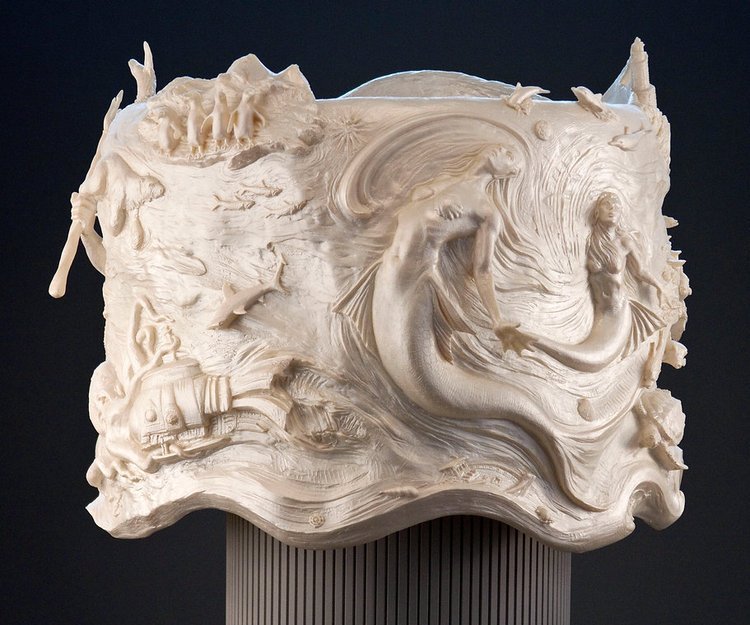
Child of the Sea alto-relief water fountain by Martin Eichinger at Quent Cordair Fine Art
Narrative artist, Martin Eichinger, has created two exceptional relief water fountains that use the force of water to rotate the art. Child of the Sea and Symphony in S Minor.
Eichinger's broader body of bronze sculpture explores relationships, aspiration, transformation, and the human experience. His works are often narrative in character, inviting viewers to discover meaning beyond the figures themselves.
Explore Relief Sculpture and Fine Art Sculpture
Quent Cordair Fine Art represents contemporary sculptors working in relief and free-standing sculpture, including Bill Mack and Martin Eichinger. Explore our collection of fine art sculpture, or contact us for personalized assistance finding artwork for your home or collection. Worldwide shipping and complimentary art visualization are available.
Related Resources