
How to Display and Light Art: A Guide for Homes, Offices, and Outdoor Spaces
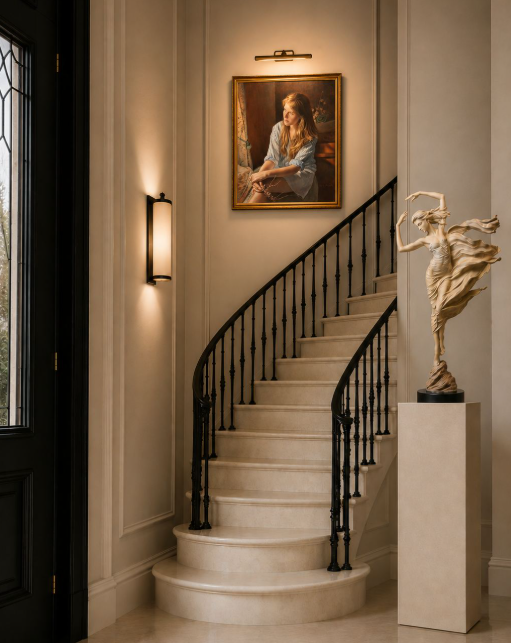
Art changes a space, but the space also changes the way art is experienced. The height of a painting, the direction of a light, the view from a favorite chair or the shifting sun across a garden can make an artwork feel intimate, dramatic, serene or unexpectedly alive.
Displaying art well is not about following an inflexible set of decorating rules. It is about giving each work enough room, visibility and light to express what made you love it in the first place.
After thirty years of helping collectors place paintings and sculpture, we have found that the most successful installations begin with a simple question: Where will this artwork be experienced most fully?
The answer may be above a fireplace, at the end of a hallway, behind a desk, commanding attention in a corporate lobby, beside a garden path or in a quiet corner that becomes meaningful because the art is there.
Begin With the Experience, Not the Empty Wall
It is tempting to begin with dimensions: there is an empty wall, so something must fit it. Measurements matter, but they are only the beginning.
Consider how people enter and move through the space. Where does the eye naturally travel? Where do people pause? Will the artwork be seen primarily while standing, sitting or approaching from a distance? A work placed along a strong sightline can draw someone through a room. A sculpture discovered gradually around a corner creates a different and often more personal experience.
Also consider the emotional role you want the art to play. A peaceful landscape may create a restorative pause in a bedroom or office. A heroic figure can bring energy and aspiration to an entryway. A joyful figurative sculpture may reward close viewing in a more intimate setting.
The right placement supports both the artwork and the life taking place around it.
How High Should Art Be Hung?
The familiar advice to hang art at eye level is a useful starting point, but eye level is not a single universal measurement. The proper height depends on the room, the artwork and how the space is used.
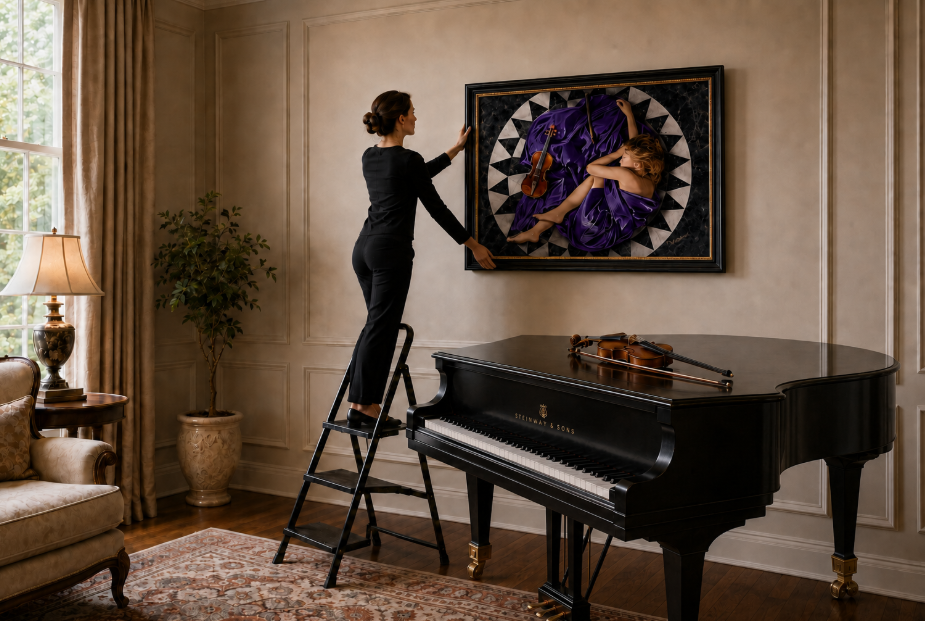
Careful attention to scale, height and sightlines allows Nocturne by Chris Dellorco to create a harmonious visual connection with a Steinway grand piano. Image: Nocturne by Chris Dellorco
In a hallway or gallery-like setting, positioning the center of the artwork approximately 57 to 60 inches from the floor often creates a comfortable viewing height. In a living room, dining room or office, however, art may be experienced mainly while seated. A slightly lower placement can feel more connected to the people and furnishings in the room.
When hanging art above a sofa, console, mantel or desk, treat the artwork and furniture as a visual grouping. If the artwork floats too high, the relationship between them is lost. The goal is not to fill every inch of wall, but to create a composition that feels intentional and balanced.
Large artworks may need to depart from standard height guidelines entirely. Let the scale of the piece, the ceiling height and the principal viewing position guide the final decision.
Choosing the Right Scale
Art that is too small for its setting can appear stranded, while art that overwhelms a space may be difficult to experience comfortably. The solution is not always a larger or smaller artwork. Sometimes a grouping, a pedestal, a change of wall or simply more breathing room creates the needed balance.
Before installation, use painter’s tape or a paper template to mark the artwork’s dimensions. Then view the outline from several positions in the room. This reveals far more than measuring the wall alone.
For collectors who find it difficult to imagine the finished result, a digital Art Visualization can place a particular painting or sculpture into a photograph of the space before a decision is made. This is especially helpful for large works, important architectural settings and rooms still being designed.
Displaying Paintings and Fine Art Prints
Paintings and prints should have enough visual space to command attention without feeling isolated from their surroundings. A single important work can anchor an entire room. Smaller pieces can create rhythm when arranged as a thoughtful group.
When assembling a grouping, look for a unifying element such as subject, color, artist, frame style or emotional tone. Keep the spacing visually consistent, and arrange the works on the floor or with paper templates before making holes in the wall.
Reflections also matter. Glass-covered prints and highly varnished paintings may catch windows, lamps or overhead fixtures. Before finalizing the location, view the work at different times of day and from the positions where it will most often be seen.
Whenever possible, keep paintings and works on paper away from direct sunlight and prolonged exposure to strong indirect daylight. Light damage is cumulative and irreversible, and works on paper, photographs, textiles and certain pigments can be especially sensitive. UV-filtering glazing or window treatments can provide additional protection, but they do not make prolonged direct sunlight harmless. Our Art Care & Preservation guide offers additional guidance for protecting paintings, prints and sculpture.
Displaying Freestanding Sculpture
Sculpture asks us to move. Its silhouette, gesture and changing relationship of light and shadow are revealed from different viewpoints.
A successful sculpture placement considers more than the front view. Walk around the proposed location and notice what will appear behind the work. A quiet background can clarify a complex form, while an open setting may allow the sculpture to interact dramatically with architecture or landscape.
Smaller sculptures can be placed on consoles, shelves or substantial tables, provided the surface is stable and the work is protected from accidental contact. Larger works often benefit from a pedestal that brings the sculpture into a natural viewing range and gives it a defined presence.
Leave enough room for the viewer to step back and, when the sculpture is designed to be seen in the round, to move around it. Consider children, pets and areas of frequent traffic as part of the installation plan. Valuable or top-heavy pieces may require professional mounting or discreet anchoring.
Displaying Relief Sculpture
Relief sculpture occupies a fascinating place between painting and freestanding sculpture. It hangs on a wall like a painting, yet its physical depth allows light to become part of the composition.
Reliefs should be mounted securely with hardware appropriate to their weight and wall construction. Because projecting forms create shadows, even a small change in lighting direction can substantially alter their appearance. Light from slightly above and to one side often reveals depth more effectively than flat, frontal illumination.
The best angle depends on the individual artwork. Experiment before permanently positioning the fixture, observing whether the shadows add definition or obscure important details.
How to Light Art Indoors
Good art lighting should reveal the work without calling attention to the fixture. It should render color faithfully, avoid distracting glare and create enough contrast for the artwork to feel present within the room.
Choose high-quality LED lighting
LEDs are generally an excellent choice because they are efficient, produce relatively little radiant heat and typically emit insignificant ultraviolet radiation. Quality varies, however. For artwork, look for a color rendering index—usually shown as CRI—of at least 90. A high CRI helps colors appear natural and nuanced rather than dull or distorted.
Color temperature describes whether white light appears warmer or cooler. At Quent Cordair Fine Art, we generally recommend LEDs between 2700K and 3500K for most art lighting. The warmer end of that range often feels comfortable in traditional interiors and with warm palettes, while 3000K to 3500K can provide a cleaner, more neutral appearance in contemporary homes, galleries and offices. Color accuracy, the character of the room and consistency among fixtures matter more than choosing one supposedly perfect number.
Whenever possible, test the light on the actual artwork before purchasing fixtures for the entire space.
To make choosing art-display and care supplies easier, we have assembled a curated Amazon storefront with art lights and light bulbs, frames, pedestals, hanging materials, cleaning and handling aids, UV-blocking window film, storage and packing supplies, rotating sculpture bases, bronze wax and other useful items for collectors.
As an Amazon Associate I earn from qualifying purchases.
Aim the light rather than flooding the room
Adjustable ceiling spots and track lighting allow each work to be illuminated individually. Aim the beam from above at an angle rather than directing it straight at the surface. If the viewer sees glare, a reflection or an exaggerated frame shadow, change the fixture angle, distance or beam spread.
A wide beam can wash a large painting evenly. A narrower beam may create drama around a sculpture but can also produce a distracting bright circle if it is too tight. Dimmers are valuable because the proper intensity changes with ambient daylight and evening use.
Avoid placing hot lamps close to artwork. Even with LEDs, allow air to circulate and follow the fixture manufacturer’s recommendations.
Light sculpture to reveal form
Sculpture comes alive through highlights and shadows. A light directly in front can flatten the form, while directional light from above or one side reveals contours, textures and gesture. Sculpture—especially a larger outdoor work—can also be illuminated from below. Carefully positioned uplighting can emphasize height, silhouette and texture, giving the work a dramatic nighttime presence. Test the angle and intensity to avoid glare or shadows that distort the form.
One primary light is often enough. For a large or complex sculpture, a softer secondary light can prevent the shadowed side from disappearing completely. The objective is not perfect symmetry; it is a natural balance that lets the work retain dimension.
View the sculpture from every important direction before settling on the lighting. The most beautiful angle from the doorway may not be the same as the view from a nearby chair or conference table.
Displaying Art in Offices and Professional Spaces
Art in a workplace does more than decorate an empty wall. It can establish character, communicate values and create an atmosphere that employees, clients, customers, and visitors remember.
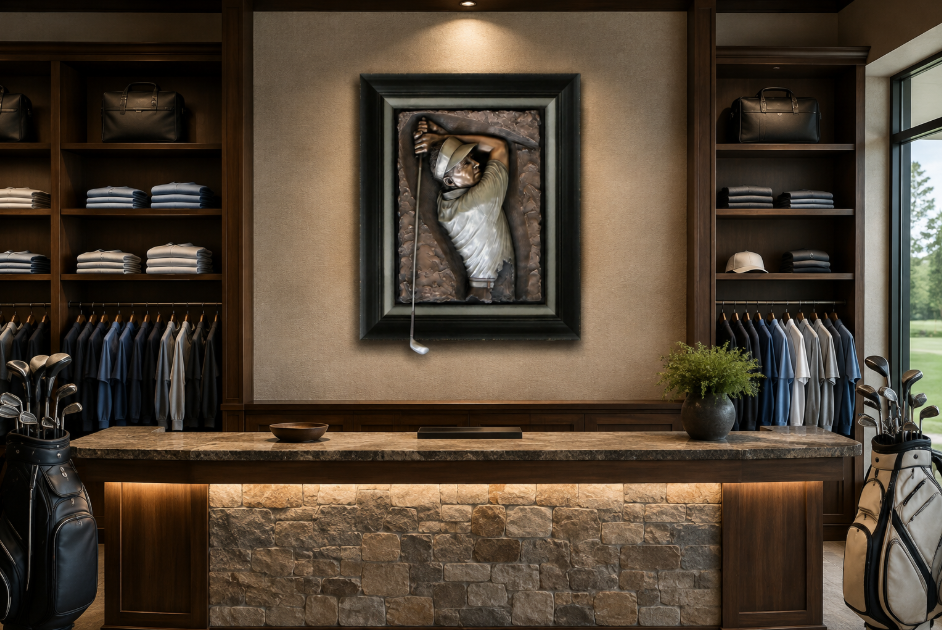
In a golf pro shop, a thoughtfully chosen relief sculpture reinforces the character of the space, while directional lighting reveals its depth, texture and movement. Image: Classic Finish by Bill Mack.
Begin with the principal experience of each area. Reception spaces may call for an artwork with immediate presence. Conference rooms reward pieces that remain engaging during long periods of viewing. Private offices can support more personal choices, while corridors may accommodate a visual sequence or collection.
Account for both seated and standing sightlines, particularly in conference rooms and waiting areas. Watch for reflections from large windows, computer screens and overhead lighting. In offices with uniform ceiling illumination, adding focused art lighting can keep the artwork from being visually lost.
Commercial installations should also consider secure mounting, accessibility requirements and traffic flow. Large, heavy or unusually placed artworks should be installed by qualified professionals.
Displaying and Lighting Outdoor Sculpture
Outdoor sculpture and fountains participate in a constantly changing composition of architecture, plants, weather and light. Their placement should be considered from inside the building as well as outside it. A sculpture framed by a window can provide pleasure throughout the year, even when no one is in the garden.
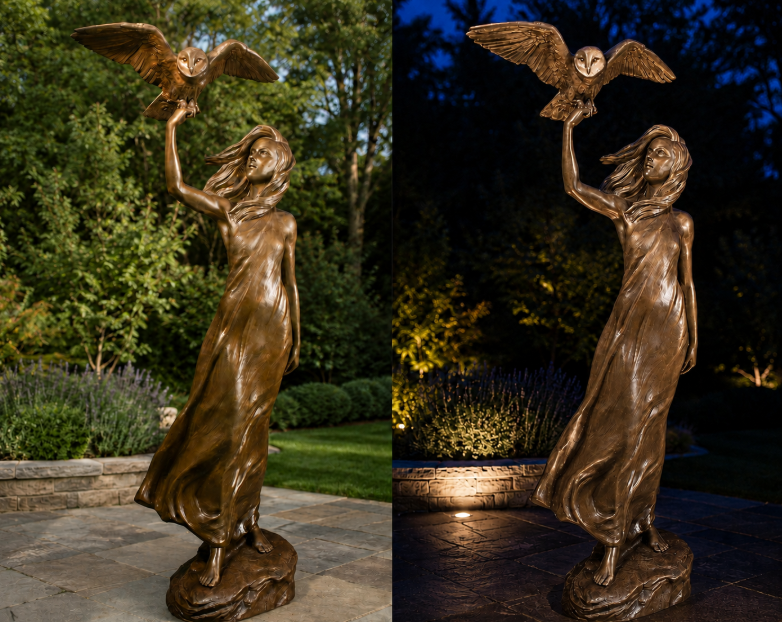
Natural daylight reveals the sculpture’s patina and relationship to the landscape, while carefully positioned uplighting brings its contours, texture and silhouette to life after dusk. Image: Taking Wing by Karl Jensen
Look for important approaches and sightlines: a gate, path, terrace, doorway or distant window. Allow adequate open space around the sculpture so landscaping does not gradually conceal it. Consider how nearby plants will change in height and density over time.
Outdoor lighting is most effective when it reveals form without creating glare for viewers or neighbors. A single fixture can produce a dramatic silhouette; two carefully balanced sources can reveal more of a sculpture in the round. Lighting from the side or at a grazing angle can emphasize texture and reveal the sculpture’s surface.
Use fixtures and electrical components rated for outdoor conditions, shield the source from direct view and have permanent wiring installed by a qualified professional. Position fixtures where they will not be damaged by maintenance equipment or buried by snow.
Outdoor placement must also suit the artwork’s material and construction. Confirm that the piece is intended for exterior display, provide a secure and stable foundation, maintain proper drainage and avoid repeated spray from irrigation systems. Follow the artist’s or gallery’s care recommendations for the specific surface, finish or patina.
Common Art-Display Mistakes
Many display problems are easy to correct. The most common include:
Hanging art too high
Choosing a work based only on wall dimensions
Using lighting that distorts color
Allowing glare to obscure the image
Placing sensitive art in direct sunlight
Flattening sculpture with frontal light
Crowding a sculpture so it cannot be viewed properly
Ignoring how a space looks from its entrances and seated positions
Installing valuable or heavy artwork without appropriate hardware
Perhaps the greatest mistake is waiting for every element of a room to be finished before choosing art. A meaningful artwork can become the point around which the rest of the space comes together.
Let the Artwork Lead
Rules can help solve practical problems, but they should never overpower the relationship between the collector, the artwork and the space.
Live with a proposed placement for a little while. Look at the work in morning light and in the evening. Sit across from it. Enter the room from different directions. Notice whether your eye is drawn toward it and whether the surrounding space allows it to speak.
When art is thoughtfully displayed and beautifully lit, it does more than complete a room, office or garden. It changes how that place feels—and how it feels to live or work there.
Quent Cordair Fine Art has helped collectors select, place and enjoy original paintings, fine art prints and sculpture since 1996. We offer personalized art consulting, worldwide shipping and complimentary Art Visualization to help you see how a work of art may look in your space before making a decision. Contact us for assistance.