
Ayn Rand-Inspired Art: A Guide to Beauty, Heroism, and Romantic Realism
A painting of a solitary figure on a rooftop at dawn can say more about a philosophy than a shelf of essays. In the best Ayn Rand-inspired art, the viewer does not merely recognize a literary influence. He feels a moral atmosphere—one of purpose, clarity, aspiration, and earned joy.
That distinction matters. Too much "philosophical art" collapses into illustration, slogan, or parody. Art shaped by Rand's ideas succeeds only when it remains fully art: visually compelling, emotionally resonant, and intelligible on its own terms. It should not require agreement with every proposition in her writing to be experienced as beautiful or profound.
Simply put, Ayn Rand-inspired art is visual art that reflects the ideals of reason, individual achievement, purposeful living, and human potential. Rather than illustrating scenes from The Fountainhead or Atlas Shrugged, the finest works communicate those values through beauty, craftsmanship, emotional clarity, and a profound respect for human life.
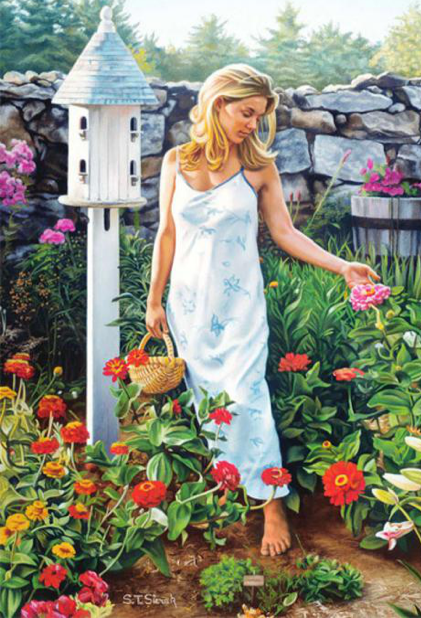
Artist: Tom Sierak
Tom Sierak transforms a simple moment in the garden into a timeless expression of beauty, serenity, and gratitude. Rich with light and color, the painting depicts that everyday moments, when fully appreciated, can become extraordinary.
Available here.
The Essential Vision of Ayn Rand-Inspired Art
At its core, Ayn Rand-inspired art is concerned with man as a heroic being. That phrase is often repeated but rarely examined with enough care. Heroism here does not mean melodrama, propaganda, or invulnerability. It means the conviction that human life has dignity, that reason is a value, and that achievement is spiritually significant.
In visual art, those convictions appear through subject matter, composition, and mood rather than overt ideology. A painter may depict an architect absorbed in thought, a dancer at the height of disciplined control, a city rising in morning light, or a quiet portrait marked by self-possession. The common thread is not political messaging. It is reverence for consciousness, competence, purposeful action, and the joy of creating.
This is one reason Romantic Realism has such a natural affinity with Rand's aesthetics. She argued for art that projects things not merely as they are, but as they might and ought to be according to an artist's value judgments. That does not require fantasy or sentimentality. It requires selectivity. The artist chooses and emphasizes what is essential to a vision of life.
One of Rand's most important contributions to aesthetics appears in The Romantic Manifesto, where she defines art as "a selective re-creation of reality according to an artist's metaphysical value-judgments." In other words, every serious work of art reflects—not by explicit argument, but by selection and emphasis—the artist's fundamental view of existence. What does he consider possible? Noble? Tragic? Admirable? Beautiful? The artist cannot include everything, so every composition becomes an act of evaluation. For Rand, this is why great art resonates so deeply. It does more than depict the visible world; it gives perceptible form to an underlying philosophy of life, allowing us to experience values emotionally as well as intellectually.
At Quent Cordair Fine Art, that philosophy has guided our collection for decades. The artists we represent are not united by imitation of Rand's novels, but by a shared commitment to craftsmanship, beauty, intelligibility, and a profound admiration for human potential.
Collectors interested in exploring these ideas through original paintings and sculpture can browse our curated collection of Ayn Rand-inspired art, where Romantic Realist artists celebrate the values of reason, achievement, beauty, and purposeful living through contemporary representational art.
Beyond Illustration: The Difference Between Influence and Imitation
Collectors interested in Ayn Rand-inspired art often begin by looking for familiar signs—skyscrapers, determined faces, industrial forms, or scenes that echo The Fountainhead and Atlas Shrugged. Those can be meaningful points of entry, but often they are not enough.
A work can borrow the visual vocabulary of Ayn Rand's novels and still miss the spirit entirely. A canvas filled with hard-edged glamour may feel cold, brittle, or merely theatrical. Likewise, a figurative painting may never depict architecture or industry and yet embody her values far more convincingly through integrity of form, emotional clarity, and admiration for human potential.
The distinction matters because the strongest works endure beyond the novelty of reference. They do not depend on the viewer recognizing a quotation or identifying a symbolic nod. Instead, they stand independently as serious works of art. Their relationship to Rand lies in philosophical kinship rather than visual cliché.
Hallmarks of Art Shaped by Rand's Ideals
The most persuasive works in this tradition tend to share several characteristics.
First, they are comprehensible. Rand believed that genuine depth does not require obscurity. Collectors drawn to her aesthetic are often drawn to works that communicate with clarity, invite sustained reflection, and reveal greater meaning with time.
Second, they affirm value. That does not mean every painting must be cheerful. Tragedy, struggle, and solitude all have a place. But the governing attitude is not cynicism. Even moments of conflict are framed in relation to meaning, effort, and the possibility of triumph.
Third, they respect reality. Rand admired stylization, but not distortion for its own sake. In visual terms, that often points toward disciplined draftsmanship, coherent anatomy, persuasive light, and believable space. The artist may idealize reality, but never abandons it.
Finally, these works inspire. Whether depicting achievement, love, quiet contemplation, or the beauty of the natural world, they remind us of what is possible at our best. That capacity to elevate the viewer—to awaken admiration, hope, or renewed purpose—is one of the defining characteristics of art shaped by Rand's aesthetic ideals.
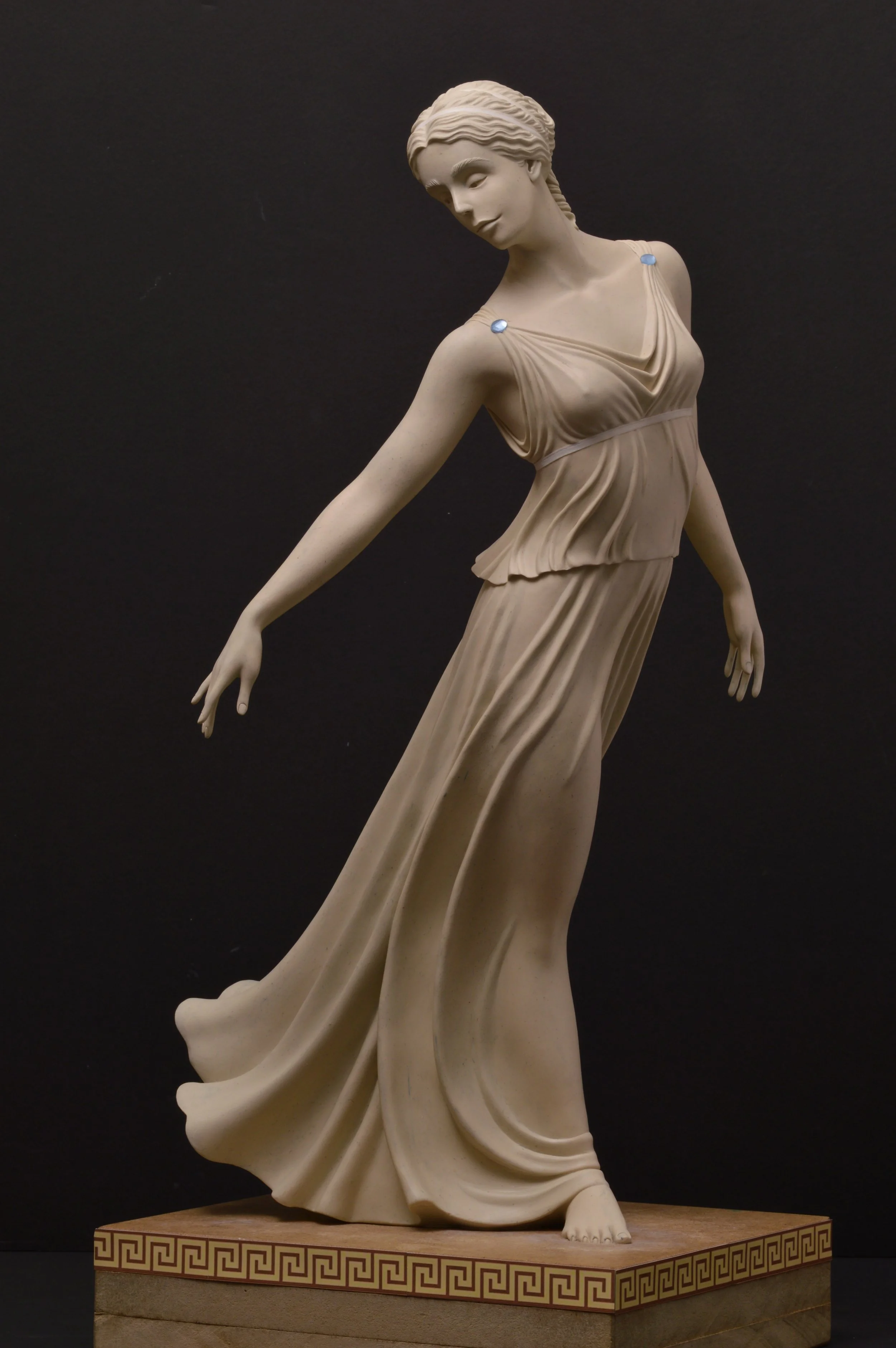
Terpsichore: Greek Muse of Dance
Artist: Holly Crocker Garcia
This sculpture celebrates the beauty of movement and the enduring power of artistic inspiration. Holly Crocker Garcia brings the classical muse to life with flowing grace and quiet strength, creating a sculpture that reflects the Romantic Realist vision of humanity at its most noble, beautiful, and uplifting.
Sculpture available here.
Why Romantic Realism Fits So Naturally
The affinity between Romantic Realism and Ayn Rand-inspired art is no accident. Both seek to unite idealism with faithful representation. They allow artists to portray recognizable people and places while projecting a distinct hierarchy of values. Beauty is not decorative excess. It is evidence of seriousness.
For collectors, this matters. A beautifully composed representational painting can elevate a home, office, or architectural space while also carrying intellectual and emotional substance. It invites repeated contemplation rather than demanding interpretation.
There is also a practical dimension. Art grounded in strong craftsmanship rewards long attention. The more one studies the composition, the drawing, the handling of light, and the intentionality of expression, the more the work reveals. For serious collectors, that staying power is among the greatest virtues of fine art.
Themes found in Ayn Rand-Inspired Art
Architecture remains one of the most natural subjects in Ayn Rand-inspired art—not because buildings are fashionable symbols of ambition, but because architecture unites utility, imagination, and human intelligence. A skyline can become a testament to what human beings are capable of achieving.
The human figure is equally central. In Ayn Rand-inspired art, the body is often presented not as fragmented object or ironic statement, but as the visible expression of will, identity, and potential. Poised stillness can be as powerful as dramatic action. A seated thinker, a standing builder, or a woman turning toward light may each suggest quiet sovereignty over one's own life.
Industry, landscape, and domestic life also belong here when approached with the proper spirit. Rand's values are not confined to steel and skylines. A luminous still life, a radiant garden sculpture, or an intimate portrait can express the same commitment to joy, order, and consciously chosen values. The subject matters less than the artist's estimate of existence.
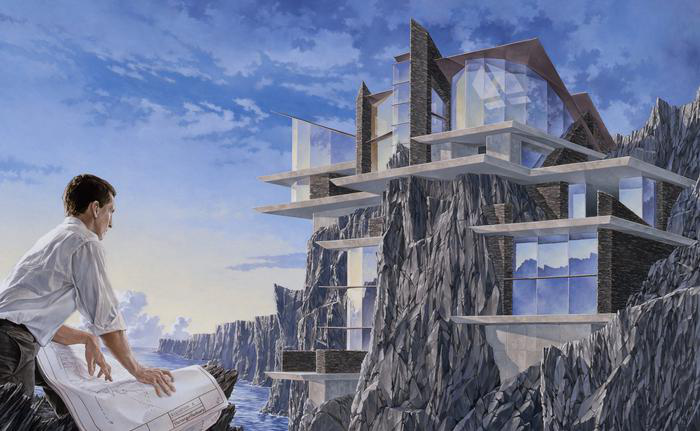
Breaking Through by Bryan Larsen portrays architecture as the visible expression of human imagination and achievement. Suspended between vision and reality, the structure rising from the cliffs reflects that intelligence, purpose, and creative ambition can reshape the world. It is a celebration not merely of what humanity builds, but of the ideas that make great achievements possible.
Prints available here.
Choosing the Right Work for Your Collection
Not every work influenced by Rand will feel equally inviting in every setting. Some lean toward intellectual austerity. Others idealize beauty so strongly that they sacrifice psychological complexity. One collector may be drawn to a bold, architectonic composition that anchors a contemporary residence, while another may prefer a lyrical figurative work that conveys the same ideals with greater warmth.
It also depends on how explicit one wishes the philosophical connection to be. Some collectors enjoy works that unmistakably reflect Rand's worldview. Others simply seek art that celebrates excellence, integrity, and individual achievement without feeling programmatic. Neither approach is inherently superior. The strongest choice is the one that remains compelling long after the initial philosophical association has faded.
Scale, medium, and placement matter as well. A commanding figurative painting may define a formal room, while a bronze sculpture inspired by heroic values can quietly transform an entryway or garden. Philosophically serious art should still serve the life lived around it.
The Hallmarks of Great Ayn Rand-Inspired Art
Begin where every judgment of fine art should begin: with the work itself. Is the composition intentional? Does the handling of light reinforce the emotional premise? Are the forms convincing? Does the image reward sustained attention?
Then ask a deeper question.
What view of man and life does this work project?
Not what statement accompanies it. Not what label someone has attached to it. What does the visual experience itself suggest about ambition, love, intelligence, achievement, happiness, or the meaning of human life?
That is where serious collecting begins. If the answer feels superficial, the philosophy probably is as well. If the answer continues to deepen with familiarity, the work may remain meaningful even for viewers who have never read a page of Rand.
For collectors, this is where philosophy and beauty become inseparable. The finest art offers more than visual pleasure. It becomes a daily reminder of the values one has chosen to admire and pursue. The right work does not preach across the room. It stands quietly in the light, asking nothing except to be seen—while reminding us that greatness remains one of art's highest and most enduring subjects.
At Quent Cordair Fine Art, we are proud to represent artists whose work embodies the enduring ideals of beauty, reason, and human potential through the tradition of Romantic Realism. Explore our collection and discover works that celebrate life as it can and should be.
Frequently Asked Questions
What is Ayn Rand-inspired art?
Ayn Rand-inspired art reflects values such as reason, purposeful achievement, individualism, human potential, and earned happiness. The strongest examples express those ideas through beauty, craftsmanship, and emotional clarity rather than literal illustration.
Does Ayn Rand-inspired art have to depict scenes from The Fountainhead or Atlas Shrugged?
No. While some artists draw inspiration from Rand's novels, the finest works stand independently as works of art. Their connection lies in shared values rather than recognizable literary references.
Why is Romantic Realism associated with Ayn Rand?
Rand described Romantic Realism as art that projects reality as it might be and ought to be according to an artist's values. Representational artists working in this tradition often emphasize beauty, competence, aspiration, and meaningful human achievement.
Can art express Rand's philosophy without being political?
Absolutely. Many paintings and sculptures communicate ideals of excellence, integrity, independence, and purpose without making political statements. Their focus is on the dignity and possibilities of human life.
What should collectors look for in Ayn Rand-inspired art?
Look first for artistic quality: thoughtful composition, skilled draftsmanship, convincing light, emotional depth, and lasting craftsmanship. Then consider whether the work projects a life-affirming vision that continues to reward attention over time.