
What Is Heroic Art? Celebrating Human Achievement and Aspiration

Terra Incognita by Bryan Larsen
Heroic art gives visible form to the qualities we admire in human beings: courage, purpose, perseverance, creative vision, independence and the determination to achieve something of value.
It may depict a figure meeting a physical challenge, an inventor absorbed in thought, an architect’s vision rising into reality, a dancer achieving complete command of movement or an explorer looking toward a world not yet reached. The subject can be monumental or intimate. What makes the work heroic is not its scale, but its view of humanity.
At its best, heroic art presents human beings as capable of thought, choice, growth and meaningful action. It reminds us not only of what has been accomplished, but of what remains possible.
What Makes a Work of Art Heroic?
Heroic art is sometimes associated with warriors, mythology, monuments or dramatic scenes of victory. Those subjects certainly belong to its long history, but heroism in art is much broader.
A heroic work may celebrate:
The courage to act despite fear or uncertainty
The discipline required to master a craft
The independence to pursue an original vision
The persistence to continue through difficulty
The intelligence that turns an idea into reality
The ambition to build, invent, discover or explore
The integrity to remain true to deeply held values
The joy of reaching a hard-earned goal
The defining quality is the artist’s estimate of the human being. Heroic art does not treat people as helpless figures pushed through life by forces beyond their control. It presents them as individuals capable of directing their lives, shaping their world and rising to meet challenges.
That does not mean the hero must be invulnerable. A figure can struggle, stumble, rest or stand alone and still be heroic. What matters is the governing direction of the work: toward purpose rather than passivity, achievement rather than resignation, and possibility rather than defeat.
Heroism Is More Than Physical Strength
Physical power is one of the oldest visual symbols of heroism. From classical sculpture to contemporary figurative art, the human body has offered artists a direct way to express strength, balance, discipline and resolve.
But some of the greatest acts of heroism begin where no one can see them: in thought.
An idea conceived in solitude may eventually become a building, a machine, a medical discovery, a work of art or a journey beyond the known world. The finished achievement may be public, but its origin is often the private decision of an individual to think independently and persist.
This is why heroic art can portray stillness as powerfully as action. A contemplative figure may embody intellectual concentration. An architect studying a plan may suggest the first stage of a structure that will change a skyline. A child imagining distant worlds may represent the curiosity from which future exploration begins.
Heroism can be muscular, but it can also be intellectual, creative, moral and deeply personal.
The Many Faces of Heroic Art
Courage, Perseverance and Self-Mastery
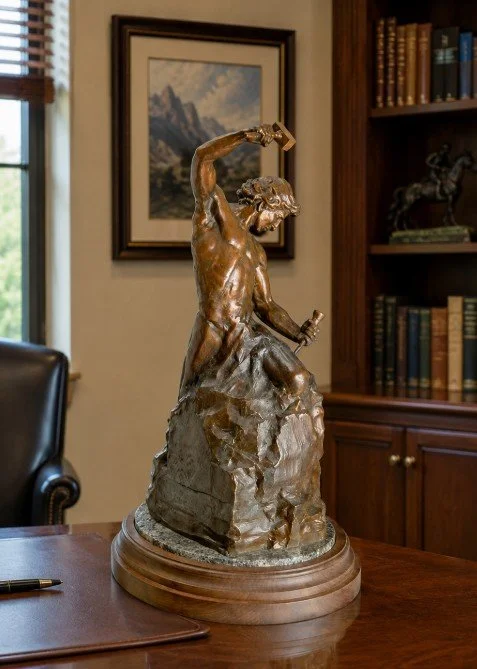
Self-Made Man by Bobbie Carlyle
Some heroic works focus on the moment of effort: the instant when a person pushes upward, breaks through resistance or refuses to surrender.
In Bobbie Carlyle’s Self-Made Man, a powerful figure carves himself from stone. The unfinished material remains part of him, making achievement not something bestowed from outside but an ongoing act of self-creation. The sculpture has become an enduring symbol of determination, personal responsibility and the ability to shape one’s own destiny.
Other works express self-mastery through poised control rather than visible struggle. The balanced figure, the disciplined dancer and the athlete suspended at the height of motion all reveal what repeated effort can make possible. Their grace is not accidental. It has been earned.
Thought, Invention and Creation
Human achievement begins with the ability to imagine something that does not yet exist.
Heroic art can honor the thinkers, builders, artists, entrepreneurs, engineers and inventors who transform ideas into reality. Their accomplishments may take very different forms, but each depends upon a mind willing to question, envision and create.
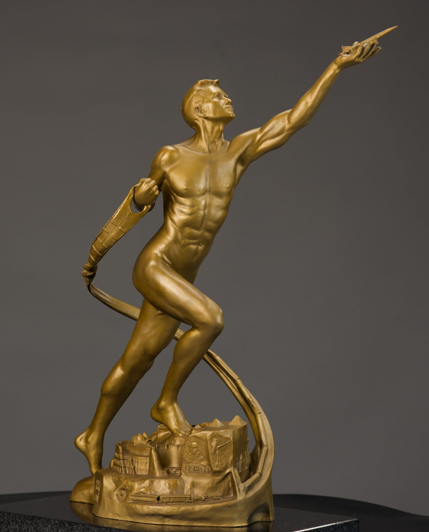
The Power of Thought by Victor Issa
Victor Issa’s The Power of Thought makes that invisible process tangible. The commanding bronze figure incorporates references to achievements in architecture, engineering, science, transportation and the arts. The sculpture directs attention beyond the finished monuments and inventions to their common source: the individual human mind.
Architecture is especially suited to heroic art because a building is both an idea and a physical fact. It begins as an act of imagination, survives countless practical challenges and eventually occupies the world. In many Bryan Larsen paintings, architecture often becomes a symbol of intelligence, ambition and humanity’s ability to reshape its environment with purpose.
Exploration, Technology and the Future
Heroic art does not have to look backward.
Images of flight, technology and space exploration continue one of art's oldest traditions: giving form to humanity's desire to move beyond present limits. These subjects celebrate more than machines. They celebrate the curiosity, knowledge and courage that make exploration possible.
A spacecraft ascending through an immense sky can evoke centuries of discovery behind it and worlds of possibility ahead. A child gazing at the stars can embody the beginning of that same journey. A futuristic city can offer a vision of civilization shaped by intelligence and human values.
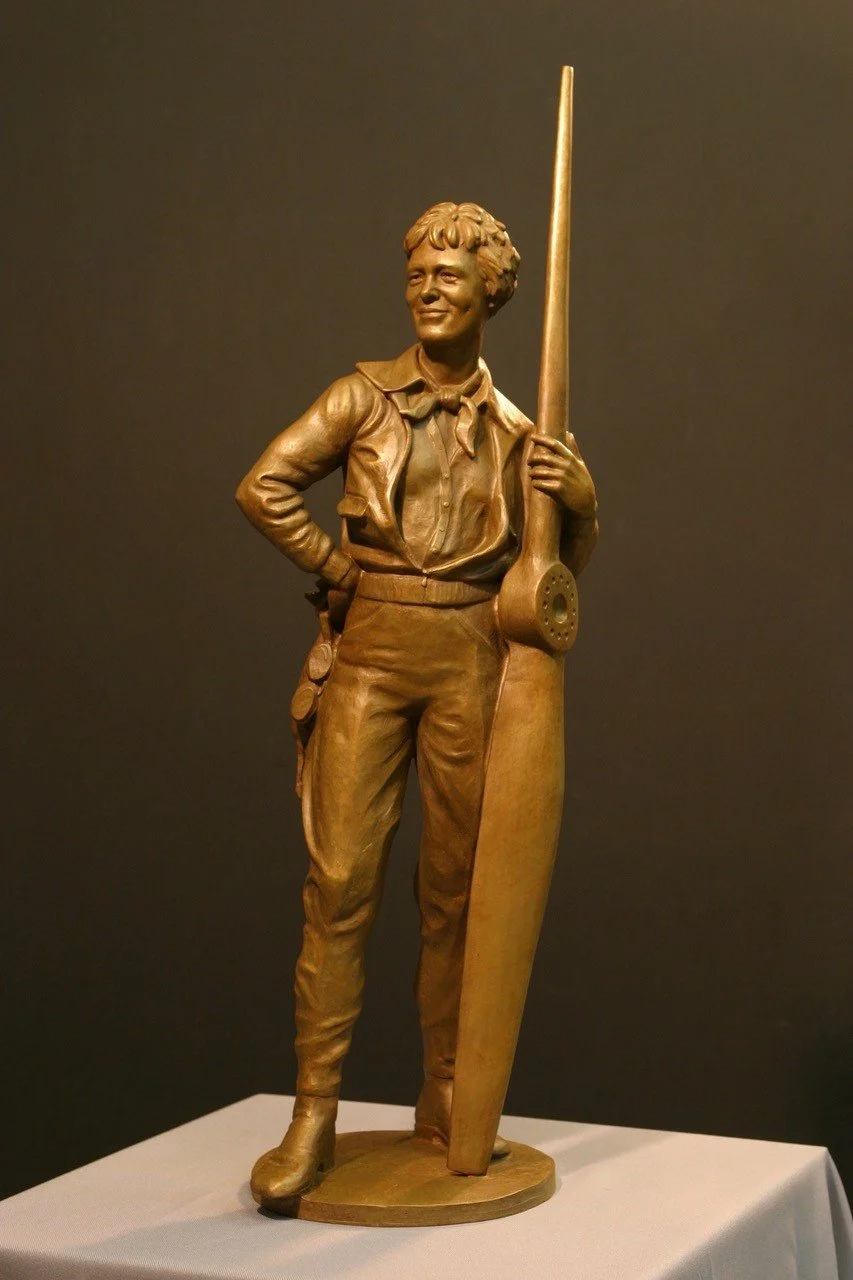
Amelia Earhart by Jay Hall Carpenter
Jay Hall Carpenter's bronze Amelia Earhart gives that spirit of exploration the form of a real historical individual. Earhart's courage, independence and determination to fly beyond the limits of her time made her an enduring symbol of aspiration—proof that heroic art can honor not only a destination reached, but the willingness to enter the unknown.
In Bryan Larsen's Terra Incognita (at the top of this page), that story of exploration stretches across centuries, bringing Alan Turing, Rosalind Franklin, Galileo Galilei, Nicolaus Copernicus and John Harrison into a vision of humanity reaching Mars. Their breakthroughs in computation, our understanding of DNA, astronomy and navigation made once-unknown territories knowable; in Larsen's painting, their achievements become part of the intellectual inheritance carrying humanity toward the next frontier.
Independence and the Choice to Rise
Not every heroic subject involves a public accomplishment. Sometimes the decisive victory is the choice to stand upright under the weight of responsibility.

Atlas in Motion by Eric Wilson
Eric Wilson’s Atlas in Motion reimagines the familiar figure of Atlas not as eternally trapped beneath a burden, but as moving through a sequence. He kneels, rises and ultimately walks free. The progression transforms a symbol of endless suffering into one of agency, self-liberation and purposeful movement.
Works such as these resonate because they do not present heroism as a quality reserved for legendary figures. They connect it to choices made in individual lives: to accept responsibility, to persevere, to think independently and to move forward.
Can Heroic Art Include Struggle?
Yes. Heroic art need not pretend that achievement is effortless or that life is free from hardship.
Without obstacles, courage has no context. Without effort, achievement has little emotional weight. A compelling heroic work may show exhaustion, uncertainty, solitude or even failure. What distinguishes it is the meaning given to those experiences.
Does the work present struggle as the whole of human existence, or as something that can be confronted? Does it reduce the individual to suffering, or reveal the strength required to endure and overcome? Does it leave us with resignation, or with renewed awareness of what courage demands?
Martin Eichinger's All Down Hill from Here gives this idea physical form. Like a contemporary Sisyphus, the straining figure braces against an unseen force; the sculpture finds heroism not in guaranteed victory, but in the enduring decision to push on when accomplishment and defeat remain precariously close.
Heroic art does not deny difficulty. It refuses to grant difficulty the final word.
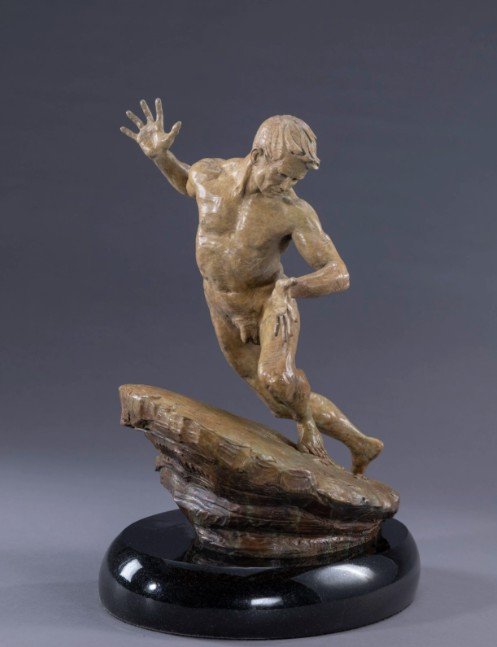
All Down Hill From Here by Martin Eichinger
Heroic Art and Romantic Realism
Heroic art and Romantic Realism have a natural affinity.
Romantic Realism portrays recognizable people, places and objects while selecting and emphasizing those aspects the artist considers most meaningful. It is concerned not merely with recording whatever happens to be visible, but with presenting a purposeful view of life.
That approach allows an artist to show human beings not only as they are in an ordinary moment, but as they can be at their most focused, courageous, joyful or fully alive. Realism gives the image credibility; romantic selectivity gives it emotional and philosophical direction.
Heroic Romantic Realism can therefore encompass far more than traditional monuments. It may include a scientist, an architect, a business builder, a dancer, a parent, an explorer, a solitary thinker or an individual quietly taking command of his or her own life.
The connection is explored from a more specifically philosophical perspective in Ayn Rand-Inspired Art: A Guide to Beauty, Heroism, and Romantic Realism. Yet heroic art is not limited to a single philosophy or audience. Its emotional appeal is widely human: admiration for excellence, courage, aspiration and achievement.
Why Do Collectors Choose Heroic Art?
The art we live with becomes part of the atmosphere of our daily lives.
A heroic painting or sculpture can serve as more than decoration. It can become a personal emblem: a reminder of a challenge overcome, a business built, an idea pursued or a value one intends to keep before oneself.
For an entrepreneur, a sculpture celebrating self-creation may reflect decades of independent effort. For a scientist or engineer, an image of discovery may honor the power of disciplined thought. For an athlete or dancer, a figure in motion may represent mastery achieved through practice. For a family, a work centered on courage or possibility may express the values they hope to pass forward.
Heroic art is particularly meaningful in offices, libraries and public spaces, where it can communicate confidence, purpose and respect for human ability. Yet it can be equally powerful in a private home. Encountered over years, the work may become woven into the collector’s own story.
The best heroic art does not shout instructions at the viewer. It offers an image worthy of contemplation and allows admiration to arise naturally.
Choosing Heroic Art for Your Home or Office
Begin with the response the artwork evokes in you.
Does the figure’s bearing communicate confidence or determination? Does the composition create a sense of upward movement? Does the work celebrate a form of achievement that matters personally to you? Does it continue to hold your attention after the first dramatic impression?
Consider, too, the kind of heroic presence you want in the space.
A monumental bronze can create a commanding focal point in an entry, garden or corporate setting. A smaller figurative sculpture may offer a more private reminder on a desk, pedestal or bookshelf. An architectural or space-inspired painting can open a room toward a larger sense of possibility, while a quieter figurative work may express courage through dignity and self-possession.
Scale and placement matter, but emotional connection matters more. The right work should not feel like a generic symbol applied to the room. It should reflect something the collector genuinely values.
Where Can I Find Heroic Art That Celebrates Human Achievement?
Quent Cordair Fine Art specializes in contemporary Romantic Realist paintings and sculpture that celebrate human achievement, aspiration, courage, creativity and the extraordinary potential of human life.
Since 1996, the gallery has helped collectors worldwide discover and acquire art that reflects their highest values. The collection includes heroic figurative sculpture, paintings inspired by architecture and invention, works honoring individual achievement, and visionary images of technology, exploration and the future.

Heroes by Bryan Larsen
Collectors can explore artists such as Bryan Larsen, whose paintings celebrate optimism, architecture, space exploration and human achievement; Bobbie Carlyle, creator of the iconic Self-Made Man; and Eric Wilson, whose Atlas in Motion transforms burden into a journey toward freedom.
Personalized art consulting is available for collectors seeking a work connected to a particular achievement, profession, life experience or value. For those considering a specific painting or sculpture, complimentary Art Visualization can also show how the artwork may look within a home, office or public space.
Heroic art ultimately asks us to look at human beings from a particular perspective: not as perfect, invulnerable or untouched by hardship, but as capable.
Capable of thought.
Capable of courage.
Capable of creating something that did not exist before.
Capable of rising.
And capable of making life better through the values we choose and the work we do.
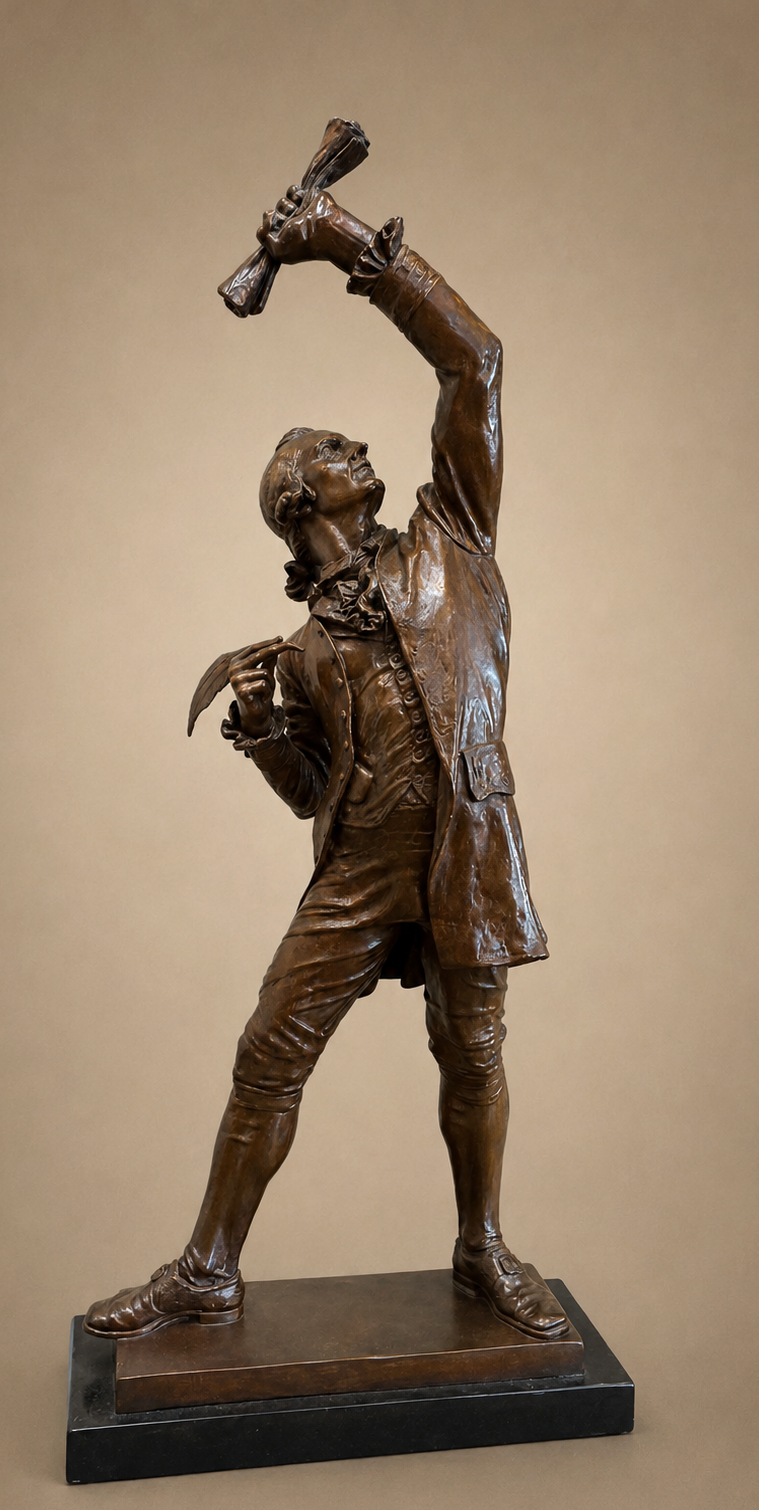
The Signer by EvAngelos W. Frudakis
Frequently Asked Questions
What is heroic art?
Heroic art celebrates qualities such as courage, purpose, perseverance, independence, creative vision and human achievement. It may portray physical strength, intellectual discovery, exploration, self-mastery or the determination to overcome a challenge.
Does heroic art have to portray a famous hero?
No. A heroic work may depict an inventor, architect, dancer, entrepreneur, explorer, parent or unknown individual. Heroism can be expressed through purposeful action, disciplined thought, moral courage or quiet perseverance as well as through dramatic deeds.
Is heroic art the same as superhero art?
Not necessarily. Superhero art generally depicts characters from comics, film or popular culture. Heroic fine art is a broader category centered on courage, aspiration, achievement and human potential. It may draw upon mythology or history, but it can also portray contemporary life, technology, creative work and deeply personal forms of triumph.
Can heroic art show hardship or struggle?
Yes. Heroic art can acknowledge difficulty, uncertainty and failure. Its defining quality is not the absence of struggle, but its view of the individual’s capacity to confront, endure or overcome it.
How is heroic art related to Romantic Realism?
Romantic Realism uses recognizable forms and skilled representation to project a selective, value-centered view of life. This makes it especially well suited to depicting human beings at their most courageous, purposeful, accomplished or aspirational.
Where can I buy heroic paintings and sculpture?
Quent Cordair Fine Art offers contemporary paintings and sculpture celebrating human achievement, aspiration, courage, invention, exploration and the potential of the individual. The gallery assists collectors worldwide from its location in Jackson Hole, Wyoming, and online at cordair.com.