
Narrative Art in the 21st Century: Why Visual Storytelling Still Matters
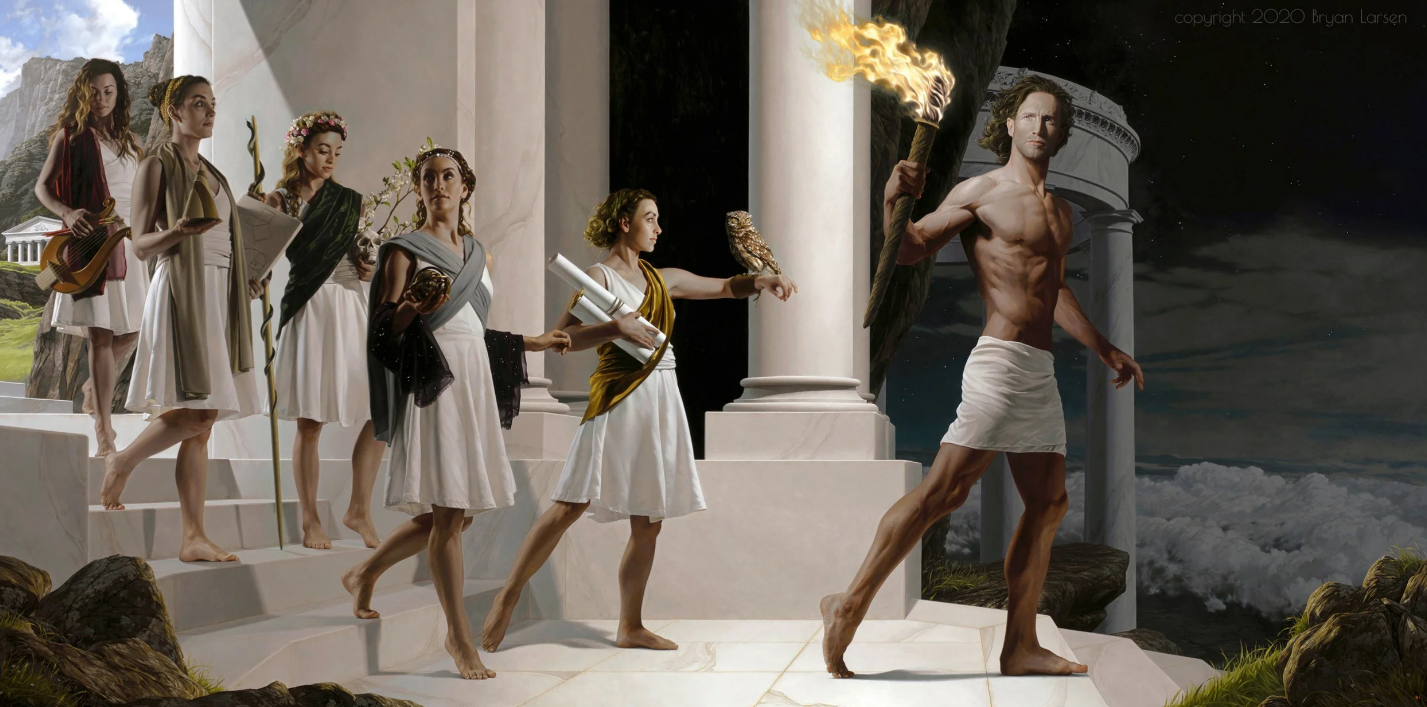
Fire of the Gods, by Bryan Larsen. Offered in three sizes.
Long before we could read, we told stories with pictures.
Across centuries and civilizations, artists have used images to preserve history, explore mythology, celebrate human achievement, express deeply held values and give visible form to the stories we tell about ourselves.
That impulse did not disappear with the arrival of photography, film or the digital age.
Narrative art is very much alive in the 21st century.
Contemporary artists continue to tell stories through paintings and sculpture, sometimes depicting recognizable events and sometimes capturing a single moment that leaves us wondering what happened before—or what might happen next.
At its best, narrative art does more than show us something.
It draws us into the story.
What Is Narrative Art?
Narrative art is art that tells, suggests or invites a story.
A narrative work may depict a specific event from history, mythology or literature. It may explore a relationship between people, portray a moment of discovery or achievement, or use symbolism and imagination to communicate an idea.
Sometimes the story is immediately apparent.
Sometimes we have to look longer.
A gesture between two figures. A destination visible in the distance. A person caught at the threshold of a decision. A spacecraft rising toward an unexplored world.
The artist may give us only one moment, but that moment can imply an entire story.
That is one of narrative art’s enduring powers: the viewer becomes a participant.
We bring our own experiences, knowledge and imagination to what we see.
Representational Art and the Power of Recognition
Narrative art has a natural home within the broader tradition of representational art—art that depicts recognizable people, places, objects or scenes from the visible world.
That recognition gives the artist a powerful language for storytelling.
We understand the human figure instinctively. We recognize a hand reaching toward another, a body straining against gravity, a face turned toward the horizon or the intimacy between two people sharing a quiet moment.
Yet not all representational art is narrative.
A still life may invite us to contemplate beauty, light and abundance without telling a story. A portrait may focus primarily on the character and presence of its subject. A landscape may celebrate the grandeur of a place without implying that an event is unfolding.
Narrative art goes a step further.
Through figures, setting, gesture, action, symbolism or implied events, it invites us to consider not only what we are seeing, but what is happening—and why it matters.
Visual Storytelling Didn’t End When Modern Life Began
We live in perhaps the most image-saturated period in human history.
Every day we encounter photographs, videos, advertisements, films and thousands of rapidly passing digital images.
One might imagine that this abundance would make narrative painting and sculpture less relevant.
Instead, it may make them more valuable.
A meaningful work of art asks something increasingly rare of us:
to stay.
A painting does not disappear after a few seconds. A sculpture does not scroll out of sight.
We can return to it.
And when a work contains a compelling narrative, returning can reveal something we did not see before—a subtle expression, an unexpected relationship, a symbolic detail or an ambiguity that changes our understanding of the story.
But we bring something new to each encounter as well: our own experiences, memories and perspectives.
The artwork has not changed.
We have.
And because of that, a story captured in a single, motionless image can continue to unfold for us over time.
From Ancient Mythology to Stories Yet to Be Lived
Narrative art has always reflected the stories, ideas and aspirations that matter to us. In the 21st century, artists continue that tradition while finding new stories to tell.
Today’s representational artists have the whole range of human experience—and imagination—available to them.
They tell stories of love and relationships, exploration and discovery, science and technology, personal transformation, mythology and imagination, courage, beauty, struggle, aspiration and human achievement.
Contemporary artist Bryan Larsen demonstrates just how expansive modern narrative art can be. His paintings move between mythology, symbolism and imagined futures, exploring recurring themes of creativity, human achievement, ingenuity, discovery and possibility.
In works such as Fire of the Gods and Triumph of Daedalus Over Fate and Futility, Larsen draws upon mythology and its enduring ideas, bringing ancient stories into a contemporary representational language.
Yet narrative art does not require an epic event.
In Muse and Medium, the story is quieter and wonderfully layered. A model pauses to admire the sculpture that has just been created of her. She has been the artist’s muse—the living inspiration for the work—and now becomes its viewer, contemplating her own image transformed through the artist and his medium into a work of art.
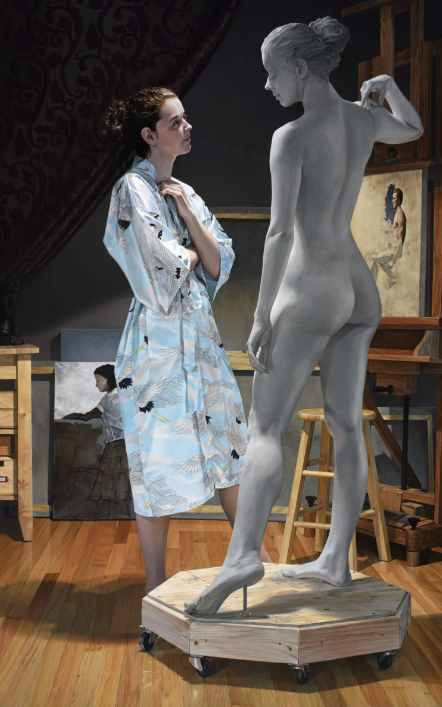
Muse and Medium by Bryan Larsen
A quiet reflection on inspiration, creation, and seeing oneself transformed through art.
Nothing dramatic needs to happen.
The story exists in the relationship between model, artist, inspiration and creation, all captured in a single reflective moment.
Elsewhere, Larsen turns toward science, technology and space exploration, imagining humanity reaching beyond the limits of the present.
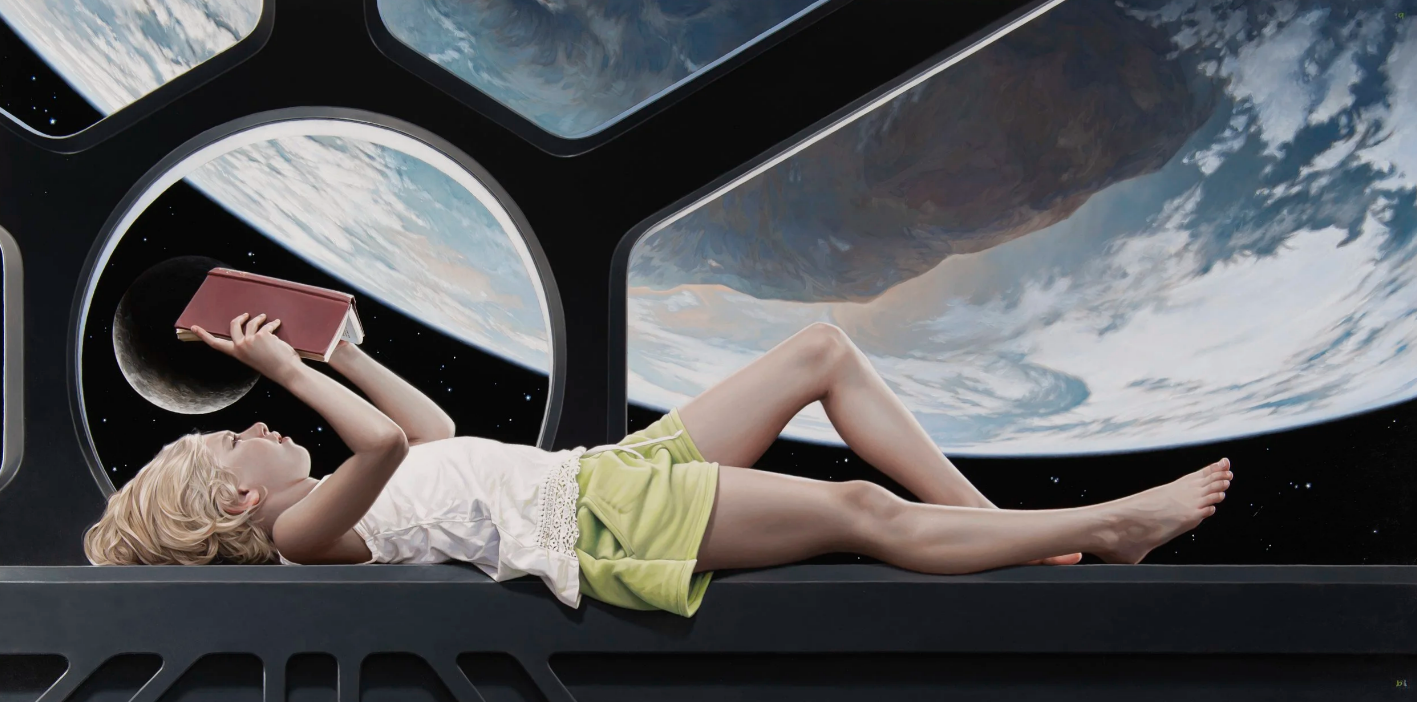
Reading by Moonlight I, by Bryan Larsen — A vision of humanity’s future where curiosity, exploration and the wonder of discovery continue beyond Earth.
His subjects may span thousands of years—or move into a future that has not yet arrived—but the underlying questions remain connected:
What can human beings imagine, create, discover and overcome?
His work demonstrates one of narrative art’s great strengths. It can revisit stories humanity has told for centuries, find meaning in a quiet human moment, and imagine stories that have yet to be lived.
Narrative art can look backward.
It can examine the present.
And perhaps most excitingly, it can look forward.
The Human Figure as Storyteller
Some stories unfold across civilizations.
Others take place within the space between two people—or entirely within a single human being.
Sculptor Martin Eichinger demonstrates how the human figure itself can become a language for storytelling. Through gesture, movement and relationships, his sculptures capture not simply poses, but moments within larger human experiences.
In Whirlwind, movement becomes part of the narrative. The figures seem caught in an unfolding moment, their energy and interaction suggesting a story already in motion.
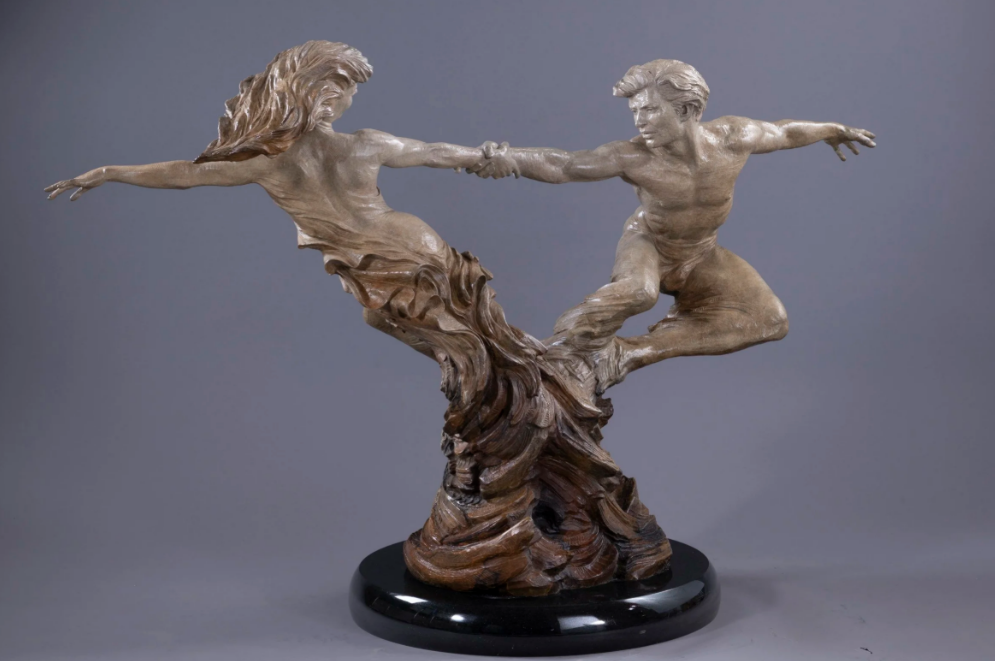
Whirlwind by Martin Eichinger— A spirited celebration of movement, connection and the exhilarating energy of two lives caught up in the moment.
Lullaby offers a quieter kind of storytelling, finding narrative in tenderness and human connection. It reminds us that visual stories need not depend on drama or spectacle. Some of the most meaningful stories unfold in moments of intimacy and care.
In From the Heart, the narrative moves inward.
Rather than pushing through difficulty, the male figure rises above it. His body leans back—open, trusting and connected to the abstract, wave-like form beneath him.
Eichinger described the figure as one who “isn’t bracing for impact... he’s letting go.”
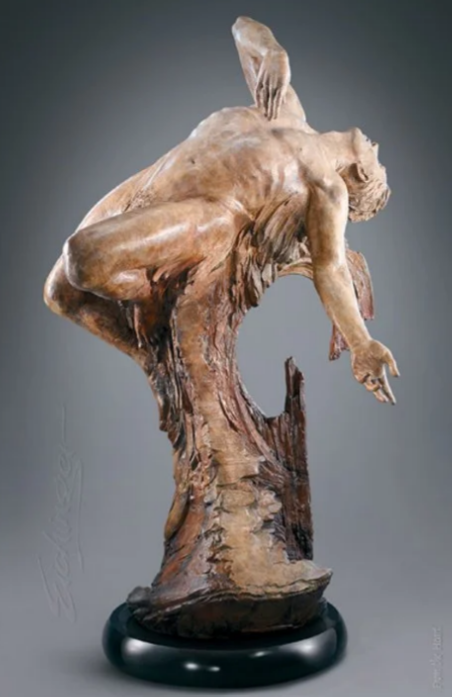
From the Heart by Martin Eichinger
A powerful expression of surrender, trust, and the freedom found in letting go.
Here, the story is not primarily about an event we can see.
It is about an inner transformation: the moment resistance gives way to trust.
Together, these works reveal how broadly narrative can operate within figurative sculpture. A story may unfold through movement between figures, through a quiet expression of human connection, or entirely within the inner life of a single person.
Sometimes the most significant journey depicted in a work of art is the one taking place within.
A Story Can Exist in a Single Moment
Narrative art does not require a complicated scene filled with characters.
Sometimes one figure is enough.
Imagine a person standing at the edge of a vast landscape.
Where are they going?
What brought them there?
Are they leaving something behind or moving toward something new?
The artist does not necessarily need to answer those questions.
The unanswered questions may be precisely what makes the work compelling.
The strongest narrative art often gives us enough information to enter the story while leaving enough unsaid for imagination to take over.
The position of a hand, the direction of a gaze, the tension or ease within a body can suggest emotion and intention without a single written word.
A sculpture can do the same.
Viewed from different angles, a three-dimensional figure may reveal an unfolding narrative through gesture, movement and expression.
The artist gives us the moment.
Our imagination gives it a before and an after.
Narrative Art Can Express Ideas as Well as Events
Not every story begins with “Once upon a time.”
Some narrative artworks tell stories through ideas.
A figure reaching upward may suggest ambition.
A person emerging from confinement may evoke liberation or transformation.
A scientist, builder or explorer may represent not only an individual but a larger story about curiosity, courage and human progress.
This is where narrative art can move beyond illustration.
The artist is not simply recording an event.
The artist is asking us to consider what the event—or even a single moment—means.
The paintings of Quent Cordair offer another approach to contemporary narrative art, using recognizable moments to explore ideas and values that extend beyond the scene itself.
Lunch Break is a contemporary nod to Maxfield Parrish’s iconic Daybreak, but its story belongs firmly to the present. The woman is in her happy place—confident in her world, embracing the day and a moment that is entirely her own: her lunch break.
The scene is simple, yet the narrative reaches beyond what she is literally doing. Her ease, independence and pleasure in the moment suggest something larger: the experience of a life confidently and joyfully lived.
Molly’s Swing carries the philosophical narrative further. The painting is a homage to freedom—to making choices and living fully.
Rather than illustrating freedom as an abstract concept, the work gives that idea human form and a lived moment. The story is not simply about the swing. It lies in what the moment represents: the freedom to choose, to act and to experience one’s own life.
Together, the paintings demonstrate how narrative art can communicate ideas without turning them into lectures.
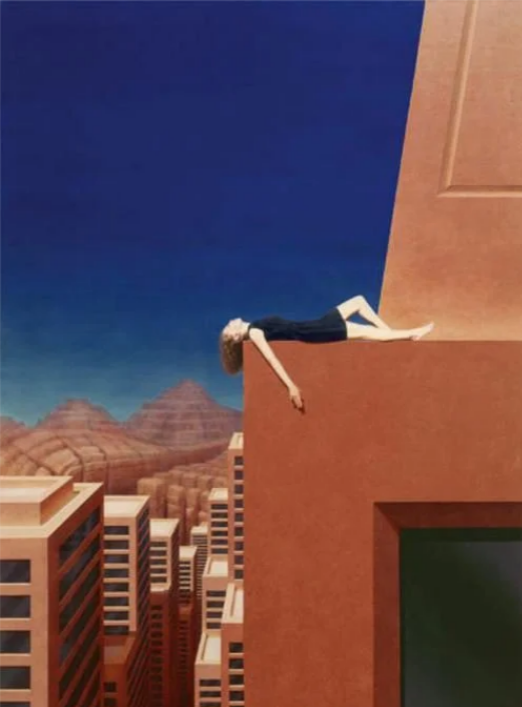
Lunch Break by Quent Cordair — A quiet celebration of confidence, contentment, and the simple pleasure of being at home in one’s world.
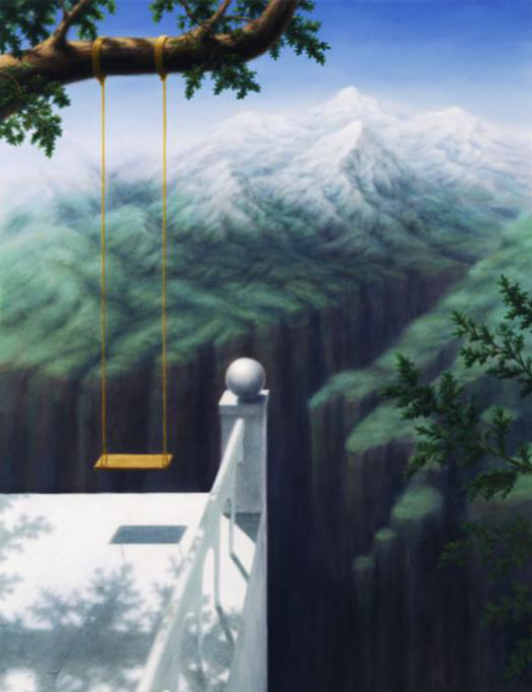
Molly’s Swing by Quent Cordair — A poetic homage to freedom, choice, and the exhilarating possibilities of a life fully lived.
The visible scene gives us a point of entry.
The meaning gives us a reason to stay.
This is another way narrative art can speak across time and beyond literal events. An artist may acknowledge the art of the past, celebrate a moment in the present, or use a recognizable human experience to give visual form to an abstract idea.
For artists working within traditions such as Romantic Realism, the choice of subject and the way it is portrayed can communicate a view of humanity itself—what is possible, what is admirable and what deserves to be celebrated.
The narrative becomes not merely something that happened.
It becomes something the artist believes is worth showing us.
Why We Still Want Stories on Our Walls
There is a profound difference between seeing an image once and choosing to live with it.
When we acquire a work of narrative art, its story becomes part of the environment of our daily lives.
A painting may remind us of adventure.
A sculpture may embody determination.
A quiet figurative scene may evoke tenderness or reflection.
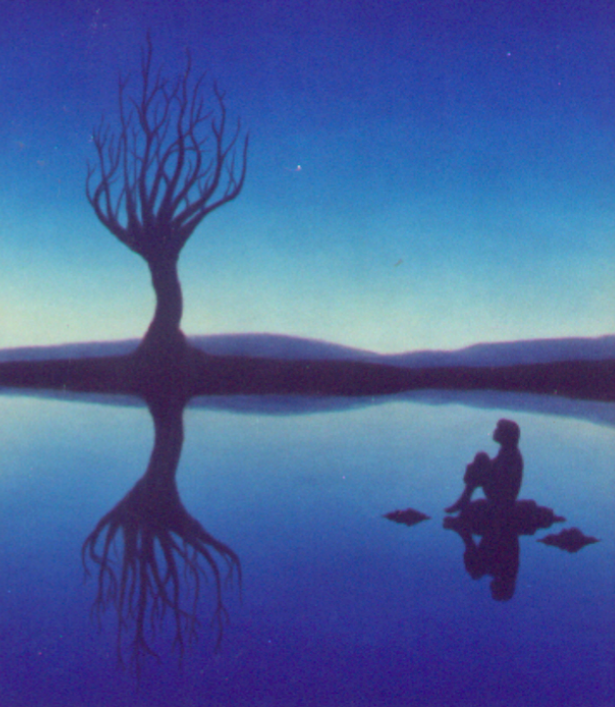
The Evening Tree by Quent Cordair
A serene invitation to pause, reflect, and find meaning in a quiet moment surrounded by beauty.
An image of exploration or achievement may remind us of possibilities still ahead.
A symbolic work may reconnect us with an idea or value that matters deeply to us.
This is one reason the art we choose for our homes can become so personal.
We are not merely choosing colors, dimensions or subjects.
We are choosing what we want to encounter again and again.
The most meaningful works often continue revealing themselves long after the first viewing.
Their stories become familiar without becoming exhausted.
The Viewer Completes the Story
Perhaps narrative art has endured because artists never have complete control over the stories their works ultimately tell.
They begin the conversation.
We finish it.
Two people can stand before the same painting or sculpture and notice entirely different things.
One may respond first to the story being depicted. Another may connect with a memory. Someone else may see an aspiration, a question, an idea or a possibility.
That does not diminish the artist’s intention.
It demonstrates the extraordinary relationship between artwork and viewer.
A successful narrative work can be specific enough to communicate something meaningful while remaining open enough to become personal.
And when we choose to live with such a work, that relationship can continue for decades.
Visual Storytelling Still Matters
Our methods of storytelling will continue to change.
New technologies will create new ways to make and experience images. Stories will move across screens, virtual spaces and forms we have yet to imagine.
Yet there remains something uniquely powerful about standing before a painting or walking around a sculpture created to embody a meaningful moment.
The image is silent.
It does not move.
And still, something happens.
We wonder.
We remember.
We imagine.
We feel.
Narrative art reminds us that a single image can contain far more than a single moment. It can hold an entire world of meaning—and invite us to enter.
At Quent Cordair Fine Art, we represent contemporary artists whose paintings and sculptures explore the human experience through beauty, imagination, emotion, ideas and visual storytelling.
From Bryan Larsen’s journeys between ancient mythology and humanity’s imagined future, to Martin Eichinger’s sculptural stories of human connection, emotion and transformation, to Quent Cordair’s philosophical narratives celebrating meaningful moments, freedom and the experience of living, their works demonstrate the remarkable breadth of narrative art in the 21st century.
The tradition of visual storytelling is not merely something preserved from the past.
It is still being written.
Explore More
Continue exploring the beauty, ideas and stories found in contemporary representational art:
What Is Romantic Realism?
Discover an artistic movement that celebrates beauty, meaning, human values and life as it can and should be.
Explore the Art of Bryan Larsen
Discover paintings inspired by mythology, science, technology, human achievement and the possibilities of the future.
Explore the Sculpture of Martin Eichinger
Discover figurative bronze sculptures that tell stories of human connection, emotion and transformation.
Explore the Art of Quent Cordair
Discover paintings that explore freedom, choice, joy and the meaningful moments of a life fully lived.
How to Start Art Collecting With Confidence
A practical guide to discovering artwork you love, trusting your own response and building a collection that is personally meaningful.